
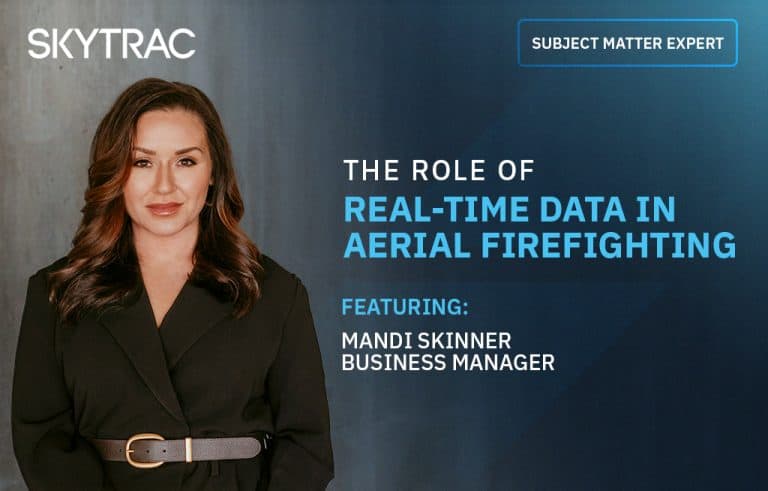
Join Mandi Skinner as she shares her insights on assisting aerial firefighting operations
In our ongoing Subject Matter Expert Series, we spoke with Mandi Skinner, SKYTRAC’s Business Manager for Western North America. Mandi supports aerial firefighting operations and has ten years of aviation experience working with government agencies and operators in forestry.
In this Q&A, she discusses how SKYTRAC technology supports aerial fire operations. She also explores the difficulties she encounters in assisting firefighters, the future of Aerial Intelligence Solutions and more.
What is your educational background?
I completed a Bachelor of Business at the University of Guelph-Humber (Toronto campus). Following graduation, I worked across various technology sectors in roles including business development and field technical sales support.
Can you share with me what drew you to aviation?
A few years ago, I was ready for a career change when a trusted colleague encouraged me to explore aviation, recognizing my strong interest in technology and recommending an opportunity at SKYTRAC.
SKYTRAC supported my transition by investing in my training and development, allowing me to build expertise across mission-critical aviation operations. Since then, I’ve worked on a range of projects, with a primary focus on emergency medical services and aerial firefighting.
What is your subject matter expertise?
I specialize in supporting mission-critical aviation projects across both fixed-wing and rotorcraft operations at SKYTRAC. My experience spans air medical programs and, more recently, forestry and wildfire response, where I focus on aligning solutions with operational and contractual requirements.
I work closely with operators to understand their requirements in wildfire missions, supporting large air tanker programs with Operational Loads Monitoring (OLM), Flight Data Monitoring (FDM), vertical lift, rappel operations, and reconnaissance/survey missions. My role involves delivering real-time data solutions that enable informed in-flight and ground-based decision-making, while ensuring safety, compliance, and continued airworthiness in demanding operating environments.
How long have you been involved in aerial firefighting, and how did you get involved?
I’ve been involved in aerial firefighting throughout my 10-year tenure at SKYTRAC, supporting projects in various capacities. Over time, I developed my expertise through hands-on experience and close collaboration with operators. I have a strong focus on responsiveness and reliability, both of which are critical in wildfire operations.
Much of my growth came from learning directly from experienced colleagues. I also stay engaged in project-based work, particularly in forestry. This industry is highly experience-driven, and my expertise has been built through continuous exposure, teamwork, and a commitment to learning in real-world environments.
What excites you about this sphere of aviation?
The demand for situational awareness in this sphere of aviation is ever-changing with extremely tight timelines. We are constantly exploring new ways to capture and acquire quality data that forestry operators can use to respond. Real-time decision making and quality data acquisition are necessary when it comes to preparing a response for wildfires. The more data we can provide our operators to access on board, the better we can help them to prepare and respond in a state of an emergency fire response.
Ground crews rarely have the luxury of long lead times, they need answers, tools, and data, yesterday. If we can help operators access that data onboard the aircraft in a way that’s fast and reliable, we can make a real difference in how they prepare and respond during emergency wildfire situations. For me, being a part of that equation is incredibly rewarding.
What is aerial firefighting’s value to other industries, people, and society?
Aerial firefighting plays a critical role in protecting communities, economies, and natural environments from the devastating impacts of wildfires. These events are highly unpredictable, driven by factors like weather and terrain, and can escalate rapidly—putting lives, homes, and livelihoods at risk.
The scale of impact can be enormous, as seen in major wildfire events like those in Southern California, where losses reached into the billions. Loss of life being the most severe outcome and some communities lost everything. The unpredictability of wildfires is the hardest to manage, and quite often it’s the things we take for granted in our everyday existence that can be lost in minutes. Effective wildfire response helps mitigate these risks, safeguarding people and preserving what matters most. It’s an essential service that often goes underappreciated until its impact is felt firsthand.
What challenges is this segment confronted with today or has been in the past?
One of the biggest challenges in this segment is operating under tight timelines and high pressure, especially as aircraft are brought into service quickly. Many fleets rely on legacy aircraft, each with unique configurations and limitations when it comes to accessing and integrating data. Because no two aircraft are the same, most solutions must be customized, particularly with varying tank, bucket, and telemetry setups.
Supporting mixed and evolving fleets requires constant adaptation. We have to develop tailored solutions for each platform, rather than relying on standardized approaches. Most of the solutions we provide are customized per aircraft type, which makes everything we do “uncommon.” When I think about the different tank & bucket configurations and telemetry data setups we have done and the wide range of aircraft we support, it’s pretty amazing.
We are constantly responding to mixed fleets or changes in aircraft. So, we have to be prepared to respond with a solution that works for that specific aircraft type. It is much easier to respond when you are familiar with the same aircraft and can duplicate what you are doing already, as opposed to coming up with a new way to access data on different aircraft types with different tank setups.
How does SKYTRAC help tackle those challenges?
SKYTRAC addresses these challenges by continuously investing in advanced technology and data acquisition capabilities, with a focus on delivering intelligent connectivity and real-time, actionable data for operators in demanding environments.
A key part of this effort is the Implementation and Support team, which specializes in avionics and installation support. Their expertise plays a critical role in project execution, research, and development, and has strengthened our ability to support complex wildfire operations.
Across the organization, there is a shared commitment to building and customizing solutions that enable safer, more effective mission performance—ensuring operators have the data they need, when they need it. Aircraft intelligence and experience working in this field is a requirement, and this team is a large part of project implementation and research & development at SKYTRAC. Every department at SKYTRAC shares that commitment. If there’s a way to pull data from an aircraft to help crews perform their jobs more safely and effectively, we will build, customize, and support it.
What capabilities are in demand in aerial firefighting?
The most in-demand capabilities in aerial firefighting center around real-time, intelligent decision-making tools that help operators respond effectively while maximizing safety and minimizing risk.
There is growing demand for live video and real-time data downlink from aircraft, giving crews immediate visibility into fire behavior, drop accuracy, and aircraft positioning. These capabilities significantly improve coordination, efficiency, and resource management. What were once considered “nice-to-have” features are now quickly becoming standard expectations in modern wildfire operations.
How do you keep connected to aerial firefighting latest trends and regulations?
I stay connected to latest trends and regulations by building strong relationships with avionics and maintenance teams. They provide direct insight into operational needs and challenges. Their real-world experience, often under intense workloads helps shape a clear understanding of what’s required in the field. It’s essential that I communicate this feedback to our research and development teams at SKYTRAC.
Those teams are very busy, you’re dealing with teams that have worked over 50+ hours of overtime in a week to stay on top of fire response missions. We have tremendous respect for them and what they do.
In addition, we attend industry conferences and workshops, collaborate with technology partners, and continuously test and validate our solutions with SKYTRAC engineering. Gathering operator feedback and exploring integration with other forestry technologies are also key. These steps ensure we stay aligned with evolving industry demands and data-sharing requirements.
We test our technology in different capacities and proof test concepts with engineering. We are constantly seeking feedback and looking for ways to integrate with other prominent forestry technologies. Partnering with other providers to offload critical data is important for SKYTRAC.
What future trends do you see that will impact aerial firefighting?
Artificial intelligence (AI) is emerging as a major trend in aerial firefighting, with growing adoption to support faster and more predictive decision-making for wildfire planning and response.
We’re also seeing an increased demand for reliable, cost-effective video downlink and real-time data capabilities to enhance safety and operational awareness. Integration with AI-driven mapping and GIS tools is becoming increasingly important. Ensuring strong connectivity to support these technologies will be critical.
Overall, these advancements are expected to improve predictability, efficiency, and decision-making in wildfire response operations. These tools will enhance greater predictability and preparation for decision making in wildfire response strategies.